

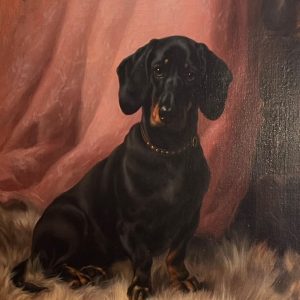

Maud Earl was one of Britain’s most accomplished canine portraitists. Born in London to George Earl and Alice Beaumont Rawlins, she inherited a rich artistic legacy. Her father George, uncle Thomas Earl, and half-brother Percy Earl were all respected animal painters. George Earl, a keen sportsman and celebrated artist, was Maud’s first teacher, insisting she study anatomy through detailed drawings of animal and human skeletons, a discipline she credited with setting her apart from other dog painters. She later studied at the Royal Female School of Art, which became part of the Central School of Art.
Earl’s early commissions came from dog shows and purebred breeders, but her reputation soon reached the highest echelons of society. Queen Victoria, a passionate dog lover, commissioned Earl to paint her favorite Collie, and other members of the royal family, including Queen Alexandra, Francis Redmond of Totteridge fame, and the Duchess of Newcastle became her patrons. She also received notable commissions from American collectors such as Hayes Blake Hoyt of the famed Blakeen Kennels.
Earl regularly exhibited at the Royal Academy, the Royal Society of British Artists, and the Paris Salon. She held several solo shows, including Canine Celebrities, British Hounds and Gun Dogs, and The Power of the Dog. Two of these were accompanied by print portfolios: British Hounds and Gun Dogs (1902) and Terriers and Toys (1903)—published by the Berlin Photoengraving Company and documenting Britain’s most prized breeds at the turn of the century. In 1897, she exhibited an extraordinary series of paintings depicting 48 different dog breeds.
In 1916, disillusioned by the aftermath of World War I, Earl moved to New York City. By then, she had achieved international acclaim, and her images were widely published in books and prints.
Her style evolved through four phases: a naturalistic, richly detailed approach (1880–1900); a looser, sketchier period (1900–1915); an “oriental” phase after arriving in the U.S., including delicate bird paintings; and finally, in the 1930s, a return to her classical, highly finished canine portraits.
Maud Earl’s work is held in prestigious collections including the Royal Collection Trust, The Kennel Club Art Gallery, the National Trust (UK), the American Kennel Club Museum of the Dog, and the New York Public Library.
Earl left behind a remarkable legacy her portraits not only captured the anatomical beauty of her subjects but their spirit, elevating dog portraiture to fine art.