

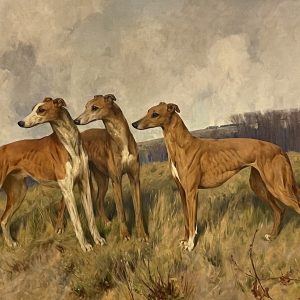

Arthur Wardle stands as one of the most prolific and versatile British artists of the late 19th and early 20th centuries. While best known today among dog enthusiasts for his exceptional portraits of purebred breeds, his body of work also includes compelling wildlife scenes and vivid depictions of exotic animals such as lions, tigers, elephants, and polar bears.
Born in London and entirely self-taught, Wardle possessed a remarkable natural talent that earned widespread recognition during his lifetime. Unlike many of his academically trained contemporaries, his distinctive and confident visual language emerged from firsthand observation, persistent study, and direct experience. His naturalistic style was grounded in realism and intentionally avoided sentimentality or anthropomorphic embellishment.
Wardle’s artistic promise emerged early: he made his debut at the Royal Academy at just sixteen and went on to exhibit over 100 works there throughout his long career. He also exhibited regularly at other prestigious venues, including the Society of British Artists. In recognition of his mastery across multiple media, oil, pastel, watercolor, and print, he was elected to the Pastel Society in 1911 and became a member of the Royal Institute of Painters in Watercolours in 1922. His reputation culminated in solo exhibitions at the Fine Art Society in 1931 and Vicars Gallery in 1935.
Though best remembered for his dog portraits, Wardle’s range extended far beyond domestic subjects. He painted sporting scenes, farm animals, and, notably, exotic wildlife, especially big cats. His unsentimental portrayals of these animals were based on hundreds of hours spent observing them at the London Zoo. Each subject was rendered with anatomical precision and expressive presence, conveying not only the animal’s likeness but also its spirit. These are not static studies; they are creatures caught in moments of instinct, emotion, and vitality.
Wardle’s talent and popularity led to his work being widely reproduced on postcards, prints, calendars, and cigarette cards, making his imagery accessible to a broad public and increasing his influence beyond traditional gallery spaces. Wardle never stopped painting. Even in his later years, he accepted private commissions, often modifying the appearance of his subjects to please patrons or highlight a breed’s most admired traits. His attention to detail, knowledge of animal anatomy, and artistic sensitivity made him one of the foremost animal painters of his generation. His extraordinary body of work continues to captivate viewers with its authenticity, technical excellence, and deep sensitivity to the living beings he portrayed.
Today, his paintings are held in major public collections including the Tate Gallery, Leeds Art Gallery, and the Ulster Museum, as well as countless private collections around the world.