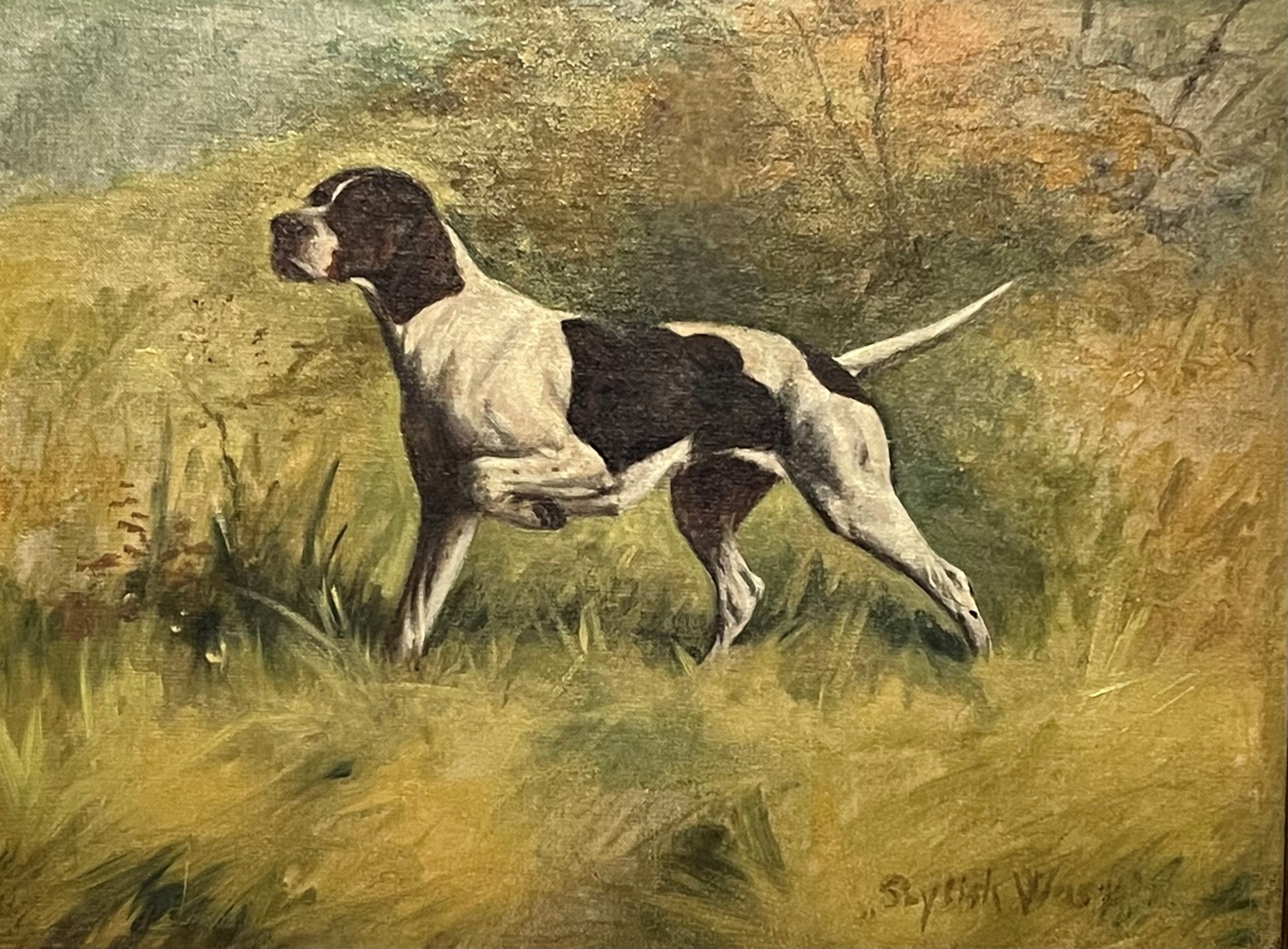
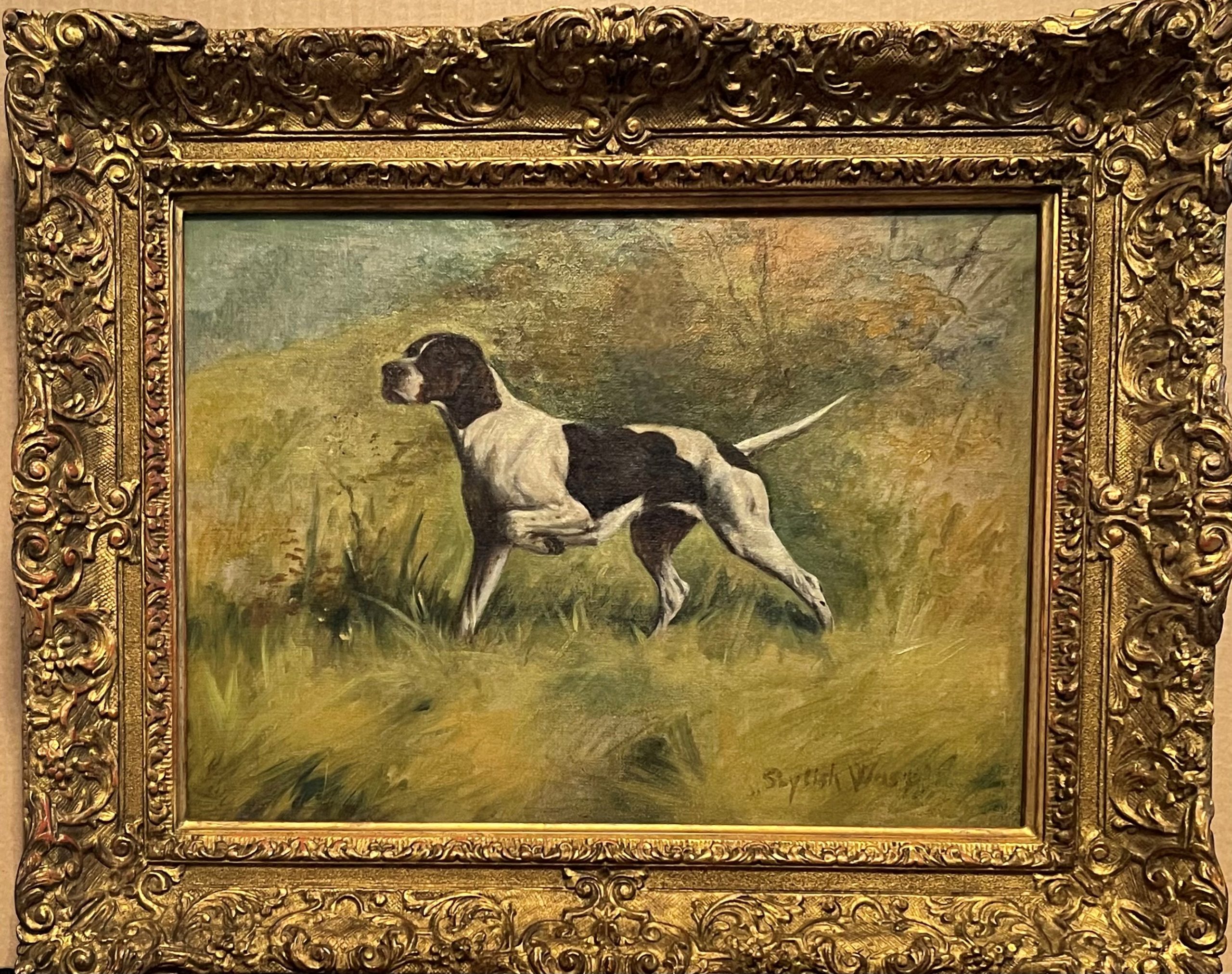
Stylish Wasp on Point

Gustav Muss-Arnolt (American, 1858-1927)
Stylish Wasp on Point
Oil on canvas mounted to masonite, 12 ½ x 16 inches
Framed: 17 x 21 ¾ inches
Provenance:
From the artist’s family; by descent to the artist’s great-grandson
Price upon request

Stylish Wasp was owned by Miss Marion DuPont and was well-known on the national field trial circuit as one of the main rivals of Becky Broomhill, who in 1922-23 became the third dog in history to win the National Field Trial Championship twice. Today, there have been seven repeat winners. No dog has ever won three times.

From the NFTC archives:

Becky Broomhill returned to the 1923 event to defend her crown and became the third dog in history to win the National in consecutive years. Wednesday morning, January 17, showcased Becky Broomhill attempting to protect her trophy against her rival, Stylish Wasp, owned by Miss Marion du Pont and handled by R. K. Armstrong.


Soon after breaking away, both simultaneously called point. It was observed that Becky had arrived first and Wasp followed. Becky broke when Harris fired and started to chase but stopped on Harris’ command. Becky was faster than Wasp and was going to all the likely places. A bunch was ridden up and shortly Becky was discovered standing near a thicket. She next pointed in the Sweet Gum trees and very quickly had her fourth bevy pinned. Harris killed a bird when they flew. Becky’s next find was near a plum thicket. After a big swing, Becky was credited with another nice find. Wasp and Becky then were worked on singles and both recorded two each. Becky’s next bevy was soon in the books. After the two-hour mark Wasp began to find birds and Becky was brought in to back one of Wasp’s finds. The roles were reversed when Becky located another covey and Wasp backed. Both were worked on singles again and it seemed that the performances were comparatively the same. The big bottom land would tell the difference. Becky handled the huge bottom by making wide casts around the area. While speeding up a hill a covey flushed and Becky stopped. Her stop was deemed acceptable. Becky was working on singles again when the covey went down a short distance away. As time was running out Wasp found two coveys and was steady for wing and shot. With one-minute remaining Becky recorded her last covey. Becky had found 10 coveys and Wasp had located six.


Gustav Muss-Arnolt was born in Germany in 1858 and emigrated to the United States around 1890, at about thirty-two years of age. He initially settled in New York City before moving to Tuckahoe, New York, in 1894.

In the early 1890s, Muss-Arnolt contributed both articles and illustrations to Harper’s Weekly, and between May 1895 and December 1909, he produced more than 170 illustrations for The American Kennel Club Gazette; two of which are now held in the AKC’s permanent collection. Deeply involved in the dog world, he was not only a prolific painter of sporting breeds but also a respected dog show judge throughout the United States, England, and Germany. From 1906 to 1909, he served on the Board of Directors of The American Kennel Club.

Muss-Arnolt was also active in New York’s art community, exhibiting his paintings at the National Academy of Design in 1880, 1881, 1886, 1887, and 1894.  Although relatively little is known about his early life and artistic training, his paintings remain enduring testaments to his skill and affection for dogs. While he portrayed many breeds, Muss-Arnolt is best known, like his contemporaries Edmund Henry Osthaus and Percival Rosseau for his dynamic depictions of pointers and setters. His work is distinguished by a darker, moodier palette and a keen ability to capture the action, tension, and vitality of the field, qualities that continue to define his legacy among American sporting artists.

Medium

Share On:

Scroll to Top